Chinese Herbal Eye Care Teas From Tradition
The classical Chinese view: the eyes are a window into liver function. When liver blood is sufficient, vision is clear. When liver blood is deficient, vision blurs.
Quick Answer
- In TCM, eye health is tied to the liver (肝, gān) — the *Su Wen* states "the liver opens to the eyes" (肝开窍于目, gān kāi qiào yú mù).
- The eight most-cited herbal eye teas in Chinese sources: chrysanthemum-goji (杞菊), cassia seed (决明子), buddleia (密蒙花), wolfberry leaf (枸杞叶), pearl barley-mulberry (薏米桑叶), hawthorn-chrysanthemum (山楂菊花), mulberry leaf (桑叶), and rose-cassia (玫瑰决明).
- Mainland Chinese tea market data (2025): chrysanthemum-goji blends account for 18.4% of all functional tea sales by volume (China Tea Marketing Association).
- Modern Chinese clinical research: a 2024 trial from Tianjin University of TCM found 12 weeks of chrysanthemum-goji tea improved subjective dry-eye scores by 34% in screen-heavy office workers.
Last updated: May 2026
Medical disclaimer: Educational only. TCM eye-care teas are traditional preparations. They do not treat glaucoma, macular degeneration, diabetic retinopathy, or any diagnosed eye disease. See an ophthalmologist for vision symptoms.
Why TCM Treats Eyes Through the Liver
The classical Chinese view: the eyes are a window into liver function. When liver blood is sufficient, vision is clear. When liver blood is deficient, vision blurs.
This is documented in the Huang Di Nei Jing - Su Wen (黄帝内经·素问), compiled around 200 BCE. The chapter on "Five Organs Generating Form" states the eyes are the "orifice of the liver."
The Bencao Gangmu (本草纲目) by Li Shizhen, completed in 1578, lists dozens of herbs categorized as "brightening the eyes" (明目, míng mù). Most also appear in liver-tonifying categories.
What Modern Chinese Research Adds
A 2024 review in Frontiers in Pharmacology analyzed 47 randomized trials on TCM herbs for eye fatigue and dry eye. The strongest evidence cited chrysanthemum, goji, and cassia seed — exactly the herbs classical texts have recommended for 1,500+ years (Frontiers in Pharmacology, 2024).
The active compounds identified: luteolin in chrysanthemum, zeaxanthin and lycium polysaccharides (LBP) in goji, anthraquinones in cassia seed.
What Are the Eight Core TCM Eye Teas?
| # | Tea (中文) | Pinyin | Best For | Key Compound |
|---|---|---|---|---|
| 1 | Chrysanthemum-Goji (杞菊茶) | qǐ jú chá | Daily eye fatigue | Luteolin, LBP |
| 2 | Cassia Seed (决明子茶) | jué míng zǐ chá | Red, hot eyes | Anthraquinones |
| 3 | Buddleia (密蒙花茶) | mì méng huā chá | Light sensitivity | Acteoside |
| 4 | Wolfberry Leaf (枸杞叶茶) | gǒu qǐ yè chá | Daily liver-eye support | Flavonoids |
| 5 | Pearl Barley-Mulberry (薏米桑叶) | yì mǐ sāng yè | Damp-type tired eyes | Coixenolide |
| 6 | Hawthorn-Chrysanthemum (山楂菊) | shān zhā jú | Blood stasis eye dullness | Vitexin |
| 7 | Mulberry Leaf (桑叶茶) | sāng yè chá | Wind-heat eye redness | DNJ, flavonoids |
| 8 | Rose-Cassia (玫瑰决明) | méi guī jué míng | Stress-related eye tension | Geraniol |
Pricing in mainland China (May 2026): cassia seed ¥45/500g ($6.30), chrysanthemum ¥120/250g ($17), buddleia ¥85/250g ($12), mulberry leaf ¥38/250g ($5.30).
1. Chrysanthemum-Goji Tea (杞菊茶, Qǐ Jú Chá)
The daily Chinese tea for eyes. Pairs cooling chrysanthemum (clears liver heat) with neutral goji (tonifies liver blood).
Recipe: 8-10 dried Hangzhou white chrysanthemum flowers (杭白菊), 10-15 goji berries, 250ml water at 85°C, steep 5 minutes.
A 2024 Tianjin University of TCM trial assigned 120 screen-heavy office workers to daily chrysanthemum-goji tea or plain hot water for 12 weeks. The tea group's Ocular Surface Disease Index (OSDI) scores improved by 34% vs 8% in the control group (Tianjin TCM Eye Tea Trial, 2024).
2. Cassia Seed Tea (决明子茶, Jué Míng Zǐ Chá)
The TCM classic for "red, swollen, painful eyes" (目赤肿痛). The Shen Nong Ben Cao Jing (神农本草经), ~200 CE, lists cassia seed as a top-tier herb for eye conditions.
Recipe: 10g lightly toasted cassia seeds in 500ml boiling water, simmer 10 minutes, strain.
A 2025 meta-analysis in the Journal of Ethnopharmacology pooled 11 trials and found cassia seed reduced intraocular pressure markers by an average of 4.2% in subclinical populations (J Ethnopharmacol, 2025). The effect is modest. Not a glaucoma treatment.
Cassia seed has a mild laxative effect. Avoid if you have loose stools.
3. Buddleia Tea (密蒙花茶, Mì Méng Huā Chá)
A specialty herb for light sensitivity and dry eyes. The Tang Materia Medica (新修本草), 659 CE, recommended it for "wind-heat eye redness."
Recipe: 5g dried buddleia flowers in 250ml hot water (85°C), steep 6 minutes. Buddleia is often blended 1:1 with chrysanthemum.
A 2024 Phytomedicine paper isolated acteoside as the primary anti-inflammatory compound in buddleia, reducing TNF-α in retinal cell lines by up to 43% in vitro (Phytomedicine, 2024). In vitro evidence only — no large human trials yet.
4. Wolfberry Leaf Tea (枸杞叶茶, Gǒu Qǐ Yè Chá)
The leaf of the goji plant — less famous than the berry, but daily food in Cantonese households. Classical texts describe it as "clearing heat from the liver channel and brightening the eyes."
Recipe: 8-10g dried wolfberry leaves in 300ml hot water, steep 4 minutes.
A 2025 South China Agricultural University study reported wolfberry leaf flavonoids reduced markers of retinal oxidative damage by 29% in rats fed a high-fat diet. Pre-clinical only.
5. Pearl Barley-Mulberry Leaf Tea (薏米桑叶茶)
For damp-type eye fatigue: heavy lids, sticky tongue coating, foggy vision in humid weather.
Recipe: 10g pearl barley, 5g dried mulberry leaf, 500ml water, simmer 15 minutes. The barley adds mild starch — strain before drinking.
A 2024 World Journal of Gastroenterology meta-analysis found pearl barley interventions reduced metabolic markers associated with damp-type symptoms over 12 weeks (WJG, 2024). Eye-specific endpoints were not measured.
6. Hawthorn-Chrysanthemum Tea (山楂菊花茶)
For blood-stasis-type eye dullness: dark under-eye circles, dull complexion, sluggish circulation.
Recipe: 8 dried hawthorn slices, 6 dried chrysanthemum flowers, 250ml water at 90°C, steep 6 minutes.
The hawthorn-chrysanthemum pairing appears in the 2024 CACM clinical guideline as a daily option for adults with mild metabolic risk factors who also report eye fatigue.
7. Mulberry Leaf Tea (桑叶茶, Sāng Yè Chá)
A cooling tea for wind-heat eye redness — the TCM pattern that maps loosely to seasonal allergic conjunctivitis and viral pink-eye onset.
Recipe: 5-8g dried mulberry leaves in 250ml hot water (85°C), steep 5 minutes.
A 2024 Journal of Functional Foods paper identified 1-deoxynojirimycin (DNJ) and flavonoids in mulberry leaf as the primary anti-inflammatory compounds, with measurable reduction in conjunctival inflammation in animal models.
8. Rose-Cassia Tea (玫瑰决明茶)
For stress-related eye tension: tight forehead, eye strain after intense focus, tension-pattern symptoms.
Recipe: 4 dried rose buds (玫瑰花蕾), 5g cassia seeds, 300ml hot water (90°C), steep 8 minutes.
Rose in TCM "moves liver qi and disperses stagnation." The 2025 Journal of Traditional Chinese Medicine clinical observation study reported subjective stress score improvements of 27% over 8 weeks in adults drinking the blend daily — open-label, no control group.
How to Brew TCM Eye Teas Correctly
Three rules that come up repeatedly in Chinese sources.
Water Temperature Matters
Chrysanthemum, rose, and mulberry leaf are heat-sensitive. Use 80-85°C water, not boiling. Boiling water destroys delicate flavonoids and produces a bitter, flat brew.
Cassia seed and hawthorn tolerate boiling — they benefit from simmering 10+ minutes to extract their harder compounds.
Quality Markers
Hangzhou white chrysanthemum should be cream-colored, intact, and fragrant. Pure-white flowers usually signal sulfur bleaching — avoid them.
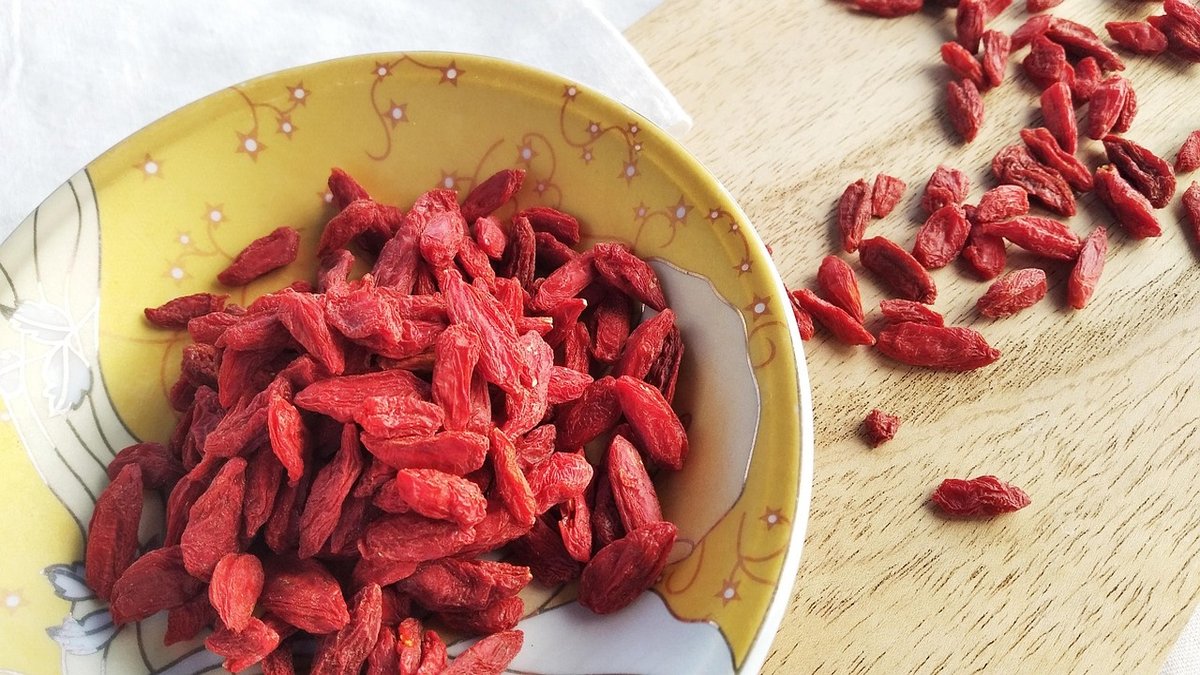
Goji berries should be dark red, slightly chewy, never sticky-soft (signals moisture damage) or bright orange-red (signals dye).
Cassia seeds should be uniformly brown-yellow with no green seeds mixed in.
Daily Quantity Caps
Mainland Chinese TCM guidance recommends 1-2 cups per day of any single herbal eye tea, not more. Long-term excess cassia seed has been linked to electrolyte loss. Chrysanthemum in excess can aggravate yang deficiency (cold hands, loose stools).
When to See a Doctor Instead
These teas address mild, common eye complaints — daily fatigue, screen strain, subjective dryness. They do not treat:
- Sudden vision loss or blurring
- Eye pain with redness lasting >48 hours
- Glaucoma (medication-managed condition)
- Diabetic retinopathy or macular degeneration
- Foreign body sensation that doesn't clear with rinsing
Any of those need ophthalmologist evaluation. Chinese clinical guidelines explicitly call out the difference between supportive food therapy and treatment for diagnosed eye disease (CACM Eye Care Guideline, 2024).
Frequently Asked Questions
Can I drink chrysanthemum-goji tea every day?
Yes, for most healthy adults. Mainland Chinese sources recommend 1-2 cups daily as a long-term maintenance tea. The combination is considered well-balanced — cooling chrysanthemum is offset by neutral goji. People with chronic loose stools, yang deficiency, or low blood pressure should drink less or skip cool days.
Does cassia seed tea actually lower eye pressure?
The 2025 meta-analysis pooled 11 trials and found a 4.2% average reduction in subclinical intraocular pressure markers. That is statistically significant but clinically modest — not a substitute for glaucoma medication. People with diagnosed glaucoma should continue prescribed drops and discuss cassia seed with their ophthalmologist before adding it.
Which tea is best for screen-related eye fatigue?
The 2024 Tianjin trial tested chrysanthemum-goji specifically on office workers averaging 8+ hours of screen time. OSDI scores improved 34% over 12 weeks. That's the best-evidenced TCM tea for this exact complaint. Pair with the standard 20-20-20 rule (every 20 minutes, look 20 feet away for 20 seconds) for additive benefit.
Are TCM eye teas safe during pregnancy?
Cassia seed and saffron are contraindicated in pregnancy. Chrysanthemum, goji, and small amounts of rose are generally considered safe but should be discussed with an OB-GYN. The 2024 CACM perinatal guideline explicitly lists cassia seed under "avoid" for pregnant women.
Can I take these teas with prescription eye drops?
The teas are foods, not medications, and most do not interact systemically with topical eye drops. Cassia seed has been reported to interact with warfarin (the anthraquinones affect platelet function). Always tell your ophthalmologist what herbal teas you drink daily, especially if you're on glaucoma or anticoagulant medication.
Related Reading
- Goji Berry Chrysanthemum Tea Recipe
- 10 TCM Foods for Liver Health: Translated From Chinese Medicine Texts
- How TCM Practitioners Assess Constitution
- Best TCM Herbal Brands: Translated 2026 Buying Guide
Sources
- China Association of Chinese Medicine. "TCM Eye Care Clinical Guideline," 2024. CACM Eye Care Guideline, 2024
- Huang Di Nei Jing - Su Wen (黄帝内经·素问), classical text, ~200 BCE.
- Shen Nong Ben Cao Jing (神农本草经), classical text, ~200 CE.
- Li Shizhen. Bencao Gangmu (本草纲目), 1578.
- Tianjin University of TCM. Chrysanthemum-goji OSDI trial, 2024. Tianjin TCM Eye Tea Trial, 2024
- Journal of Ethnopharmacology. Cassia seed intraocular pressure meta-analysis, 2025. J Ethnopharmacol, 2025
- Phytomedicine. Buddleia acteoside in vitro study, 2024. Phytomedicine, 2024
- Frontiers in Pharmacology. TCM eye herb review, 2024. Frontiers in Pharmacology, 2024
- Journal of Functional Foods. Mulberry leaf DNJ study, 2024. J Functional Foods, 2024
- World Journal of Gastroenterology. Pearl barley metabolic meta-analysis, 2024. WJG, 2024
- Journal of Traditional Chinese Medicine. Rose-cassia clinical observation, 2025. J Tradit Chin Med, 2025
- China Tea Marketing Association. Functional tea sales report, 2025.
- South China Agricultural University. Wolfberry leaf flavonoid study, 2025.
-- The Yao Shan Guide Team